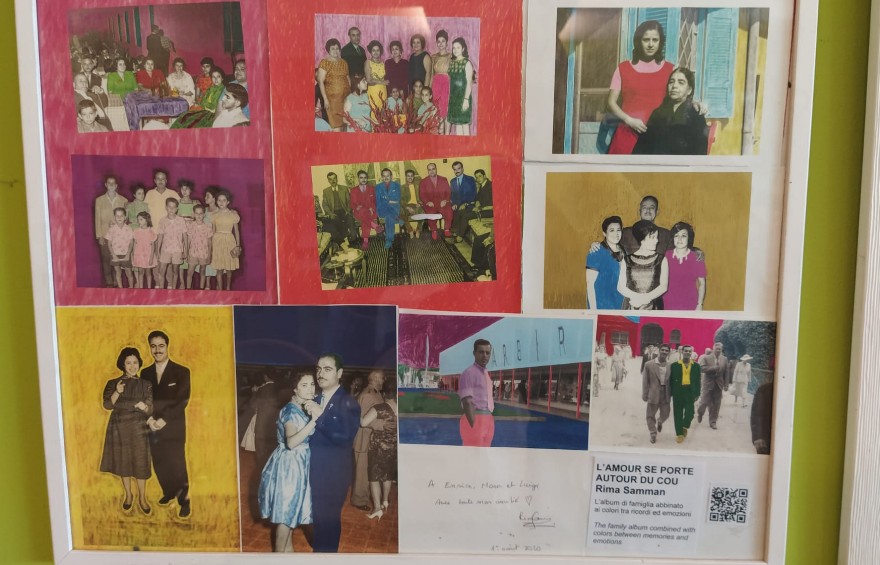
L’amour se porte autour du cou
Rima Samman
“As a child, I was captivated by the phantasmagoric imagination that
overflowed with my parents’ family album. I really liked to immerse myself in
it in my spare time, especially during their nap time. I told myself then a
bunch of fictionalized stories, inspired by Egyptian films then broadcast on
Lebanese TV. Later, I left Lebanon with only one photo in my suitcase: that of
my boyfriend in a swimsuit, smiling at me on the beach. My family photos, the
need to (a) see them here at my home in France, came much later. I won’t be
able to say when exactly. But for a few years, I noticed that my mother gave
them to me more. more readily with each passage in Lebanon. So I wondered if
the advancing age, my mother did not seek to bequeath to me via these photos, a
family memory made precisely to be transmitted and enriched from ascending to
descending. if, as in a handover of family jewels, she does not It was not
unconscious to leave them one day in my turn to my nieces and nephews, for lack
of having children myself. ”“From a certain number of years after death, the face does not change. The
sharpness of the features, the fire of the pupils, the shine of the gaze
remain. Time is conquered. The loved one is there, in front of us, in photo,
and will be forever. Shrouded in an eternal aura. Wear no longer has any hold
on him. His portrait is no longer just a portrait: he is the disappeared being
himself “Inaccessible to time henceforth. Untouchable. Untouchable. Alive. And
so in the centuries of centuries.”
Of all of them what is left at the end? Some pictures. A portrait that we
pass on to each other, that we emerge from time to time to show the
grandchildren and great grandchildren who Uncle Pierre was, who was Grandma of
Oran. “
Da bambina, ero
affascinata dalla fantasmagorica immaginazione che traboccava dall'album di
famiglia dei miei genitori. Mi piaceva molto immergermici nel tempo libero,
soprattutto durante i loro riposini. Mi raccontavo allora un sacco di storie
romanzate, ispirate ai film egiziani trasmessi dalla TV libanese. In seguito,
lasciai il Libano con una sola foto in valigia: quella del mio ragazzo in
costume da bagno, che mi sorrideva sulla spiaggia. Le mie foto di famiglia, il
bisogno di vederle qui a casa mia in Francia, arrivarono molto più tardi. Non
saprò dire quando esattamente. Ma per alcuni anni, notai che mia madre me le
regalava più volentieri a ogni passaggio in Libano. Così mi chiesi se, con
l'avanzare dell'età, mia madre non cercasse di lasciarmi in eredità, attraverso
queste foto, un ricordo di famiglia fatto apposta per essere trasmesso e
arricchito di ascendenza e discendente. Se, come in una consegna di gioielli di
famiglia, non fosse inconsapevole lasciarli un giorno a mia volta alle mie
nipoti e nipoti, per non aver avuto figli io stesso."
“A partire da un certo
numero di anni dopo la morte, il volto non cambia. La nitidezza dei tratti, il
fuoco delle pupille, la lucentezza dello sguardo rimangono. Il tempo è vinto.
La persona amata è lì, davanti a noi, in una foto, e lo sarà per sempre.
Avvolta in un'aura eterna. L'usura non ha più presa su di lui. Il suo ritratto
non è più solo un ritratto: è lui stesso l'essere scomparso. “Inaccessibile al
tempo d'ora in poi. Intoccabile. Intoccabile. Vivo. E così nei secoli dei
secoli.” Di tutti loro, cosa rimane alla fine? Alcune foto. Un ritratto che ci
trasmettiamo a vicenda, che emergiamo di tanto in tanto per mostrare ai nipoti
e ai pronipoti chi era lo zio Pierre, chi era la nonna di Orano. “